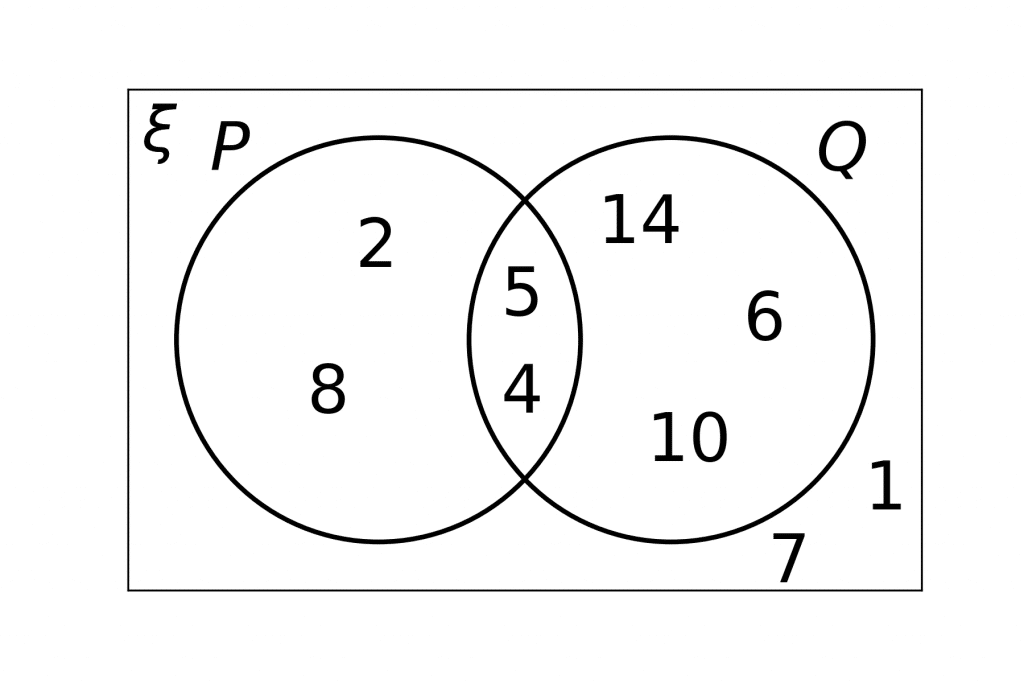
Each question is followed by a clear explanation or a model answer.
Part A — 10 Subjective Questions (with suggested answers & explanations)
1. Define a set. Explain the difference between an element and a subset. Give two examples.
Suggested answer: A set is a well-defined collection of distinct objects called elements. If \(a\) is an element of set \(A\), we write \(a\in A\). A subset \(B\) of \(A\) means every element of \(B\) is also in \(A\), written \(B\subseteq A\). Example 1: \(A=\{1,2,3\}\); here \(2\in A\) (element). Example 2: \(B=\{1,2\}\) is a subset of \(A\), \(B\subseteq A\). Another example: the empty set \(\varnothing\) is a subset of every set.
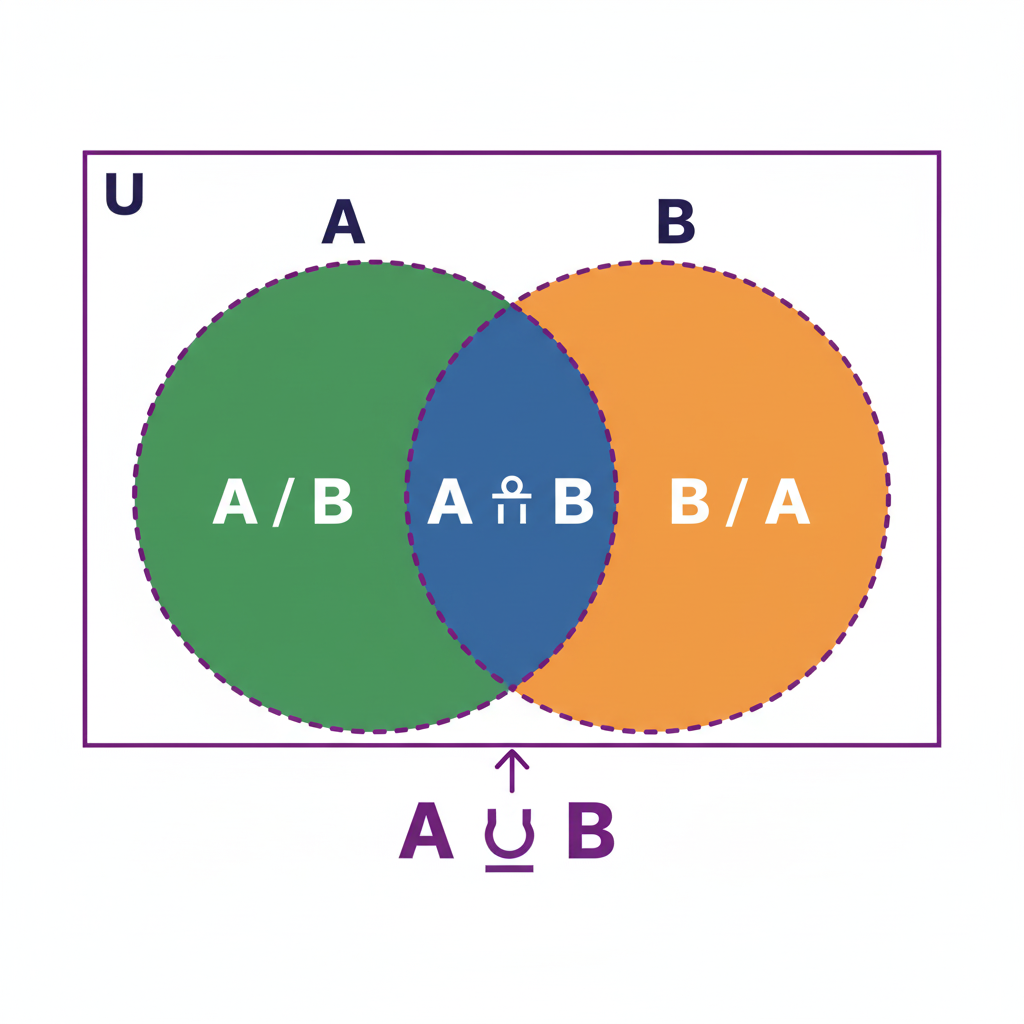
2. Explain union, intersection and difference of sets and illustrate with a Venn diagram description for sets \(A\) and \(B\).
Suggested answer:
Venn diagram by Simeon Leo Union: \(A\cup B=\{x\mid x\in A \text{ or } x\in B\}\). Intersection: \(A\cap B=\{x\mid x\in A \text{ and } x\in B\}\). Difference: \(A\setminus B=\{x\mid x\in A \text{ and } x\notin B\}\). In a two-circle Venn diagram, the overlap is \(A\cap B\); the whole area covered by either circle is \(A\cup B\); the part of \(A\) not overlapping with \(B\) is \(A\setminus B\).
3. What is a power set? If \(A=\{a,b\}\), list \(\mathcal{P}(A)\) and count its elements.
Suggested answer: The power set \(\mathcal{P}(A)\) is the set of all subsets of \(A\). For \(A=\{a,b\}\): \[ \mathcal{P}(A)=\{\varnothing,\{a\},\{b\},\{a,b\}\}. \] It has \(2^{|A|}=2^2=4\) elements.
4. Define the Cartesian product \(A\times B\). If \(A=\{1,2\}\) and \(B=\{x,y\}\), write \(A\times B\).
Suggested answer: The Cartesian product \(A\times B\) is the set of ordered pairs \((a,b)\) with \(a\in A\) and \(b\in B\). For given \(A,B\): \[ A\times B=\{(1,x),(1,y),(2,x),(2,y)\}. \] Note that in general \(A\times B\neq B\times A\) because ordered pairs respect order.
5. Explain De Morgan's laws for sets and show how they apply to complements: \((A\cup B)^c\) and \((A\cap B)^c\).
Suggested answer: De Morgan's laws state: \[ (A\cup B)^c = A^c\cap B^c,\qquad (A\cap B)^c = A^c\cup B^c. \] Intuition: "not (in \(A\) or \(B\))" means "not in \(A\) and not in \(B\)". Conversely, "not (in \(A\) and \(B\))" means "not in \(A\) or not in \(B\)".
6. Describe what a partition of a set is. Give an example partitioning \(\{1,2,3,4\}\).
Suggested answer: A partition of a set \(S\) is a collection of nonempty, disjoint subsets whose union is \(S\). Example partition of \(\{1,2,3,4\}\): \(\{\{1,2\},\{3\},\{4\}\}\). These blocks are pairwise disjoint and together cover the entire set.
7. Define countable and uncountable sets. Is the set of integers \(\mathbb{Z}\) countable? Is the interval \([0,1]\) countable?
Suggested answer: A set is countable if it is finite or has the same cardinality as the natural numbers \(\mathbb{N}\) (i.e. can be listed). \(\mathbb{Z}\) is countable (one can interleave positives, negatives, zero). The interval \([0,1]\) is uncountable — Cantor's diagonal argument shows no listing covers all real numbers in \([0,1]\).
8. Explain bijection, injection and surjection between sets. Give a simple example of a bijection from \(\{1,2,3\}\) to \(\{a,b,c\}\).
Suggested answer: Injection (one-to-one): distinct inputs map to distinct outputs. Surjection (onto): every element of the target has a preimage. Bijection = both injection and surjection (a perfect pairing). Example bijection: \(f:\{1,2,3\}\to\{a,b,c\}\) with \(f(1)=a,f(2)=b,f(3)=c\).
9. Given sets \(A\) and \(B\) where \(|A|=m\) and \(|B|=n\), how many functions \(f:A\to B\) exist? Explain.
Suggested answer: Each of the \(m\) elements of \(A\) can be sent to any of the \(n\) elements of \(B\). So the number of functions is \(n^m\). (Independent choices for each domain element.)
10. Explain the relationship between equivalence relations and partitions.
Suggested answer: Every equivalence relation on a set partitions the set into equivalence classes (each class contains elements equivalent to each other). Conversely, any partition determines an equivalence relation: two elements are equivalent iff they belong to the same block. So partitions ↔ equivalence relations.
Part B — 10 Objective (Multiple-Choice) Questions with Answers & Explanations
1. If \(A=\{1,2,3\}\) and \(B=\{3,4\}\), what is \(A\cup B\)?
A. \(\{1,2\}\)
B. \(\{3,4\}\)
C. \(\{1,2,3,4\}\)
D. \(\varnothing\)
Answer: C. \(\{1,2,3,4\}\).
Union takes all distinct elements from both sets.
2. Which of the following is the power set of \(\{x\}\)?
A. \(\{\{x\}\}\)
B. \(\{\varnothing,\{x\}\}\)
C. \(\{x\}\)
D. \(\{\varnothing\}\)
Answer: B. \(\{\varnothing,\{x\}\}\).
Power set contains all subsets: the empty set and the set itself.
3. True or False: \(\varnothing \subseteq \{1,2\}\).
A. True
B. False
Answer: A. True.
The empty set is a subset of every set by definition.
4. Let \(A=\{1,2,3,4\}\). How many 2-element subsets does \(A\) have?
A. 4
B. 6
C. 8
D. 12
Answer: B. 6.
Number is \(\binom{4}{2}=\dfrac{4\cdot3}{2}=6\).
5. If \(A\cap B=\varnothing\), we say \(A\) and \(B\) are:
A. equal
B. complementary
C. disjoint
D. subsets
Answer: C. disjoint.
Disjoint sets have empty intersection.
6. How many functions exist from a 2-element set to a 3-element set?
A. 5
B. 6
C. 8
D. 9
Answer: D. 9.
Number of functions = \(3^2=9\) (each of 2 domain points has 3 choices).
7. Which relation on \(\{1,2\}\) is an equivalence relation?
A. \(\{(1,1),(2,2)\}\)
B. \(\{(1,1),(1,2)\}\)
C. \(\{(1,1)\}\)
D. \(\{(1,2),(2,1)\}\)
Answer: A. \(\{(1,1),(2,2)\}\).
This is reflexive, symmetric and transitive on the two elements (trivial equivalence classes \(\{1\},\{2\}\)).
8. If \(A\times B=\{(1,a),(1,b),(2,a),(2,b)\}\), what are \(A\) and \(B\)?
A. \(A=\{1\}, B=\{a,b,2\}\)
B. \(A=\{1,2\}, B=\{a,b\}\)
C. \(A=\{a,b\}, B=\{1,2\}\)
D. Not enough information
Answer: B. \(A=\{1,2\}, B=\{a,b\}\).
Ordered pairs show first coordinate takes values 1,2 and second a,b.
9. True or False: If \(|A|=3\) then \(|\mathcal{P}(A)|=6\).
A. True
B. False
Answer: B. False.
Power set size is \(2^{|A|}=2^3=8\), not 6.
10. Let \(U\) be the universal set and \(A\subseteq U\). Which identity is correct?
A. \(A\cup A^c = \varnothing\)
B. \(A\cup A^c = U\)
C. \(A\cap A^c = U\)
D. \(A\cap A^c = A\)
Answer: B. \(A\cup A^c = U\).
An element is either in \(A\) or in its complement; union is the whole universe.