

Probability Questions
40 Multiple-Choice and 10 Subjective Questions
Part 1: Multiple-Choice Questions
1. What is the probability of rolling a 3 on a standard six-sided die?
2. A bag contains 5 red marbles and 3 blue marbles. What is the probability of picking a red marble?
3. What is the probability of getting heads on a coin flip?
4. A card is drawn from a standard 52-card deck. What is the probability that it is a King?
5. The probability of an event happening is 0.4. What is the probability of the event not happening?
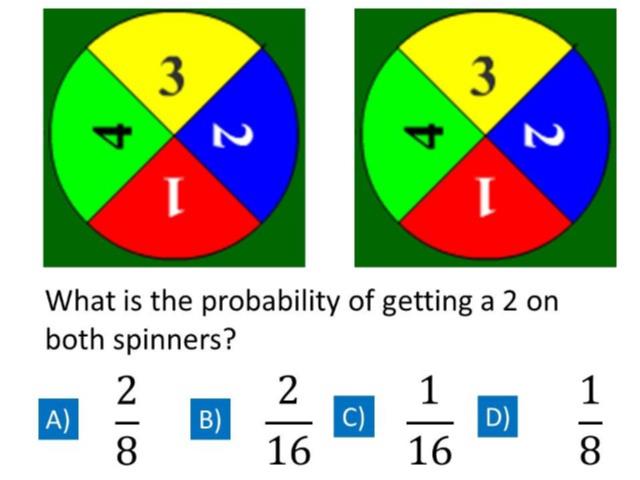
6. A spinner has 4 equal sections: red, blue, green, and yellow. What is the probability of landing on blue?
7. A jar contains 10 pens: 4 black, 3 red, and 3 blue. What is the probability of drawing a black pen?
8. What is the probability of rolling a number greater than 4 on a six-sided die?
9. A letter is chosen at random from the word "PROBABILITY". What is the probability of choosing the letter 'B'?
10. In a class of 20 students, 8 are boys. What is the probability of randomly picking a girl?
11. What is the probability of flipping a coin and getting heads, and then rolling a 6 on a die?
12. You roll a six-sided die twice. What is the probability of rolling a 5 on both rolls?
13. A bag contains 4 red balls and 6 blue balls. You draw a ball, replace it, and then draw another. What is the probability that both balls are red?
14. What is the probability of drawing an Ace from a deck of cards, replacing it, and then drawing a Queen?
15. The probability of rain on Saturday is 0.7, and the probability of rain on Sunday is 0.8. What is the probability of it raining on both days?
16. You roll a six-sided die and flip a coin. What is the probability of rolling an even number and getting tails?
17. A couple plans to have two children. What is the probability they will have a boy and then a girl?
18. The probability of passing a test is 0.9. What is the probability of passing two consecutive tests?
19. A bag has 3 green and 2 yellow balls. You draw a ball, don't replace it, and draw another. What is the probability of drawing two green balls?
20. What is the probability of rolling a 1 or a 2 on a single six-sided die?
21. What is the probability of drawing an Ace or a King from a standard 52-card deck?
22. What is the probability of rolling a 4 or an odd number on a six-sided die?
23. In a class, 15 students play soccer, 10 play basketball, and 5 play both. If there are 30 students in total, what is the probability that a randomly selected student plays soccer or basketball?
24. What is the probability of drawing a red card or a King from a standard deck?
25. Two dice are rolled. What is the probability that the sum of the numbers is 7 or 11?
26. In a box of 10 shirts, 5 are red and 5 are blue. 3 red shirts have stains. What is the probability that a randomly chosen red shirt has a stain?
27. The probability that a student is on the honor roll is 0.7. The probability that they are on the honor roll and an athlete is 0.3. What is the probability that a student who is on the honor roll is also an athlete?
28. The probability of having a cold is 0.1. The probability of having a headache given that you have a cold is 0.8. What is the probability of having both a cold and a headache?
29. A bag contains 8 red and 4 blue marbles. A marble is drawn and not replaced. What is the probability that the second marble drawn is blue, given the first was red?
30. If $P(A) = 0.5$ and $P(B) = 0.4$, and $P(A \cap B) = 0.2$, what is $P(A \cup B)$?
31. What is the probability of rolling a number divisible by 3 on a six-sided die?
32. A bag contains 20 balls: 10 red, 5 green, and 5 blue. What is the probability of picking a green or a blue ball?
33. A coin is flipped three times. What is the probability of getting exactly two heads?
34. If $P(A) = 0.6$ and $P(B|A) = 0.5$, what is $P(A \cap B)$?
35. A drawer contains 6 pairs of socks. If you randomly pick two socks, what is the probability that they are a matching pair?
36. A box contains 5 red pens and 5 blue pens. You draw a pen, don't replace it, and then draw another. What is the probability that both are the same color?
37. Two fair six-sided dice are rolled. What is the probability that the sum is a prime number?
38. From a group of 5 men and 4 women, a committee of 3 is to be formed. What is the probability that the committee consists of exactly 2 men and 1 woman?
39. If $P(A|B) = 0.7$ and $P(B) = 0.4$, what is $P(A \cap B)$?
40. In a group of 100 students, 60 study Spanish, 40 study French, and 20 study both. What is the probability that a student studies neither Spanish nor French?
Part 2: Subjective Questions
41. You have a fair coin and a six-sided die. If you flip the coin and roll the die, what is the probability of getting heads and a number less than 4? Show your work.
42. A company produces electronic devices. The probability that a device is defective is 0.05. A quality control team tests 3 devices. What is the probability that at least one of them is defective? Explain your method.
43. What is the expected value of rolling a single six-sided die?
44. A bag contains 7 red and 3 blue marbles. You draw two marbles without replacement. What is the probability that you draw one red and one blue marble? Show your calculation.
45. A survey shows that 80% of students like pizza, and 60% of students like hamburgers. 50% of students like both. What is the probability that a randomly chosen student likes pizza or hamburgers?
46. The probability of a soccer team winning is 0.6, and the probability of them drawing is 0.3. What is the probability of them losing their next match? Justify your answer.
47. Explain the difference between independent and dependent events, providing an example for each.
48. You are drawing cards from a 52-card deck. What is the probability of drawing a Spade, then a Heart, without replacement? Show your steps.
49. A test for a disease is 98% accurate. 1% of the population has the disease. A person tests positive. What is the probability that they actually have the disease? Use Bayes' Theorem and explain your variables.
50. A box contains 10 pens, 4 of which are red. If you randomly select 3 pens, what is the probability that all 3 are red?
Answers and Explanations
1. A. $\frac{1}{6}$
There is only one side with a '3' on a standard six-sided die. The total number of possible outcomes is 6.
2. B. $\frac{5}{8}$
The total number of marbles is $5+3=8$. The number of favorable outcomes is 5 (red marbles). The probability is $\frac{5}{8}$.
3. B. 0.5
A fair coin has two sides, heads and tails. There is one favorable outcome (heads) out of two total possibilities. $\frac{1}{2} = 0.5$.
4. A. $\frac{1}{13}$
A standard deck has 52 cards. There are 4 Kings in the deck. The probability is $\frac{4}{52}$, which simplifies to $\frac{1}{13}$.
5. B. 0.6
The sum of the probability of an event happening and the probability of it not happening is always 1. So, $1 - 0.4 = 0.6$.
6. C. $\frac{1}{4}$
There is one blue section out of a total of 4 equal sections.
7. B. $\frac{4}{10}$
There are 4 black pens out of a total of $4+3+3=10$ pens.
8. B. $\frac{1}{3}$
The numbers greater than 4 on a die are 5 and 6. There are 2 favorable outcomes out of 6. The probability is $\frac{2}{6}$, which simplifies to $\frac{1}{3}$.
9. B. $\frac{2}{11}$
The word "PROBABILITY" has 11 letters. The letter 'B' appears twice. The probability is $\frac{2}{11}$.
10. B. $\frac{12}{20}$
Out of 20 students, $20-8=12$ are girls. The probability is $\frac{12}{20}$.
11. A. $\frac{1}{12}$
The events are independent. The probability of heads is $\frac{1}{2}$. The probability of rolling a 6 is $\frac{1}{6}$. Multiply the probabilities: $\frac{1}{2} \times \frac{1}{6} = \frac{1}{12}$.
12. C. $\frac{1}{36}$
The probability of rolling a 5 on one die is $\frac{1}{6}$. Since the rolls are independent, you multiply the probabilities: $\frac{1}{6} \times \frac{1}{6} = \frac{1}{36}$.
13. B. $\frac{16}{100}$
The probability of the first ball being red is $\frac{4}{10}$. Since the ball is replaced, the probability of the second ball also being red is $\frac{4}{10}$. Multiply them: $\frac{4}{10} \times \frac{4}{10} = \frac{16}{100}$.
14. C. $\frac{4}{52} \times \frac{4}{52}$
Since the card is replaced, the events are independent. The probability of an Ace is $\frac{4}{52}$ and the probability of a Queen is $\frac{4}{52}$. You multiply the probabilities.
15. A. 0.56
The events are independent. You multiply the probabilities: $0.7 \times 0.8 = 0.56$.
16. A. $\frac{1}{4}$
The probability of an even number (2, 4, 6) is $\frac{3}{6} = \frac{1}{2}$. The probability of tails is $\frac{1}{2}$. Multiply them: $\frac{1}{2} \times \frac{1}{2} = \frac{1}{4}$.
17. C. $\frac{1}{4}$
The probability of having a boy is $\frac{1}{2}$, and the probability of having a girl is $\frac{1}{2}$. Multiply them: $\frac{1}{2} \times \frac{1}{2} = \frac{1}{4}$.
18. B. 0.81
The events are independent. Multiply the probabilities: $0.9 \times 0.9 = 0.81$.
19. B. $\frac{3}{5} \times \frac{2}{4}$
The probability of the first ball being green is $\frac{3}{5}$. Since it's not replaced, there are now 2 green balls and 4 total balls. The probability of the second ball being green is $\frac{2}{4}$. You multiply these.
20. B. $\frac{2}{6}$
Rolling a 1 and rolling a 2 are mutually exclusive events. You add their individual probabilities: $\frac{1}{6} + \frac{1}{6} = \frac{2}{6}$.
21. A. $\frac{4}{52} + \frac{4}{52}$
Drawing an Ace and drawing a King are mutually exclusive events. You add their probabilities.
22. C. $\frac{4}{6}$
The outcomes are rolling a 4 (1 outcome) or an odd number (1, 3, 5, which are 3 outcomes). The total favorable outcomes are $1+3=4$. The probability is $\frac{4}{6}$.
23. A. $\frac{20}{30}$
Using the formula $P(A \cup B) = P(A) + P(B) - P(A \cap B)$, we have: $\frac{15}{30} + \frac{10}{30} - \frac{5}{30} = \frac{20}{30}$.
24. B. $\frac{26+4-2}{52}$
There are 26 red cards and 4 Kings, but 2 of those Kings are red. You must subtract the overlap to avoid double-counting.
25. D. $\frac{8}{36}$
The pairs that sum to 7 are (1,6), (2,5), (3,4), (4,3), (5,2), (6,1) (6 pairs). The pairs that sum to 11 are (5,6) and (6,5) (2 pairs). Total favorable outcomes: $6+2=8$. Total possible outcomes are $6 \times 6 = 36$.
26. C. $\frac{3}{5}$
This is a conditional probability. Given that the shirt is red (the total is now 5), what is the probability that it has a stain (3 out of 5).
27. C. $\frac{0.3}{0.7}$
This is a conditional probability problem. $P(\text{athlete|honor roll}) = \frac{P(\text{athlete and honor roll})}{P(\text{honor roll})}$.
28. A. $0.1 \times 0.8$
Using the multiplication rule for dependent events: $P(A \cap B) = P(A) \times P(B|A)$.
29. B. $\frac{4}{11}$
Since one red marble was already drawn and not replaced, there are now 11 total marbles left, and still 4 of them are blue.
30. A. 0.7
Using the formula for the union of events: $P(A \cup B) = P(A) + P(B) - P(A \cap B) = 0.5 + 0.4 - 0.2 = 0.7$.
31. B. $\frac{2}{6}$
The numbers on a six-sided die divisible by 3 are 3 and 6. There are 2 favorable outcomes out of 6 total.
32. B. $\frac{10}{20}$
Picking a green or a blue ball are mutually exclusive events. Add the number of green and blue balls: $5+5=10$. The probability is $\frac{10}{20}$.
33. C. $\frac{3}{8}$
The possible outcomes are HHH, HHT, HTH, THH, HTT, THT, TTH, TTT (8 total). The outcomes with exactly two heads are HHT, HTH, and THH (3 total).
34. A. 0.3
Using the multiplication rule for dependent events: $P(A \cap B) = P(A) \times P(B|A) = 0.6 \times 0.5 = 0.3$.
35. A. $\frac{1}{11}$
There are 12 total socks. After picking one, there are 11 socks left. Only 1 of those remaining socks is the matching pair.
36. B. $(\frac{5}{10} \times \frac{4}{9}) + (\frac{5}{10} \times \frac{4}{9})$
This is the probability of picking two red pens (dependent events) PLUS the probability of picking two blue pens (dependent events).
37. A. $\frac{15}{36}$
The prime sums are 2 (1 way), 3 (2 ways), 5 (4 ways), 7 (6 ways), and 11 (2 ways). Total ways: $1+2+4+6+2 = 15$. Total possible outcomes are $6 \times 6 = 36$.
38. A. $\frac{\binom{5}{2}\binom{4}{1}}{\binom{9}{3}}$
The number of ways to choose 2 men from 5 is $\binom{5}{2}$. The number of ways to choose 1 woman from 4 is $\binom{4}{1}$. The total number of ways to choose 3 people from 9 is $\binom{9}{3}$. The probability is the ratio of favorable outcomes to total outcomes.
39. A. 0.28
The multiplication rule states $P(A \cap B) = P(B) \times P(A|B) = 0.4 \times 0.7 = 0.28$.
40. A. 0.2
The probability of studying Spanish or French is $P(S \cup F) = P(S) + P(F) - P(S \cap F) = \frac{60}{100} + \frac{40}{100} - \frac{20}{100} = \frac{80}{100} = 0.8$. The probability of studying neither is $1 - 0.8 = 0.2$.
Subjective Answers
41. Answer
The probability of getting heads on a coin flip is $\frac{1}{2}$. The probability of rolling a number less than 4 (1, 2, or 3) on a six-sided die is $\frac{3}{6} = \frac{1}{2}$. Since the events are independent, we multiply their probabilities: $\frac{1}{2} \times \frac{1}{2} = \frac{1}{4}$.
42. Answer
The easiest way to solve this is to find the probability of the opposite event: that none of the three devices are defective. The probability of a single device not being defective is $1 - 0.05 = 0.95$. Since the devices are independent, the probability of all three being non-defective is $(0.95)^3 \approx 0.8574$. The probability that at least one is defective is $1 - 0.8574 = 0.1426$.
43. Answer
The expected value of rolling a single six-sided die is the sum of each outcome multiplied by its probability.
$E(X) = (1)\frac{1}{6} + (2)\frac{1}{6} + (3)\frac{1}{6} + (4)\frac{1}{6} + (5)\frac{1}{6} + (6)\frac{1}{6} = \frac{1+2+3+4+5+6}{6} = \frac{21}{6} = 3.5$.
44. Answer
There are two ways to draw one red and one blue marble: (Red then Blue) or (Blue then Red).
$P(\text{Red then Blue}) = \frac{7}{10} \times \frac{3}{9} = \frac{21}{90}$.
$P(\text{Blue then Red}) = \frac{3}{10} \times \frac{7}{9} = \frac{21}{90}$.
The total probability is the sum of these two mutually exclusive events: $\frac{21}{90} + \frac{21}{90} = \frac{42}{90} = \frac{7}{15}$.
45. Answer
Using the formula for the union of two events: $P(\text{Pizza or Hamburgers}) = P(\text{Pizza}) + P(\text{Hamburgers}) - P(\text{Both})$.
$P(P \cup H) = 0.8 + 0.6 - 0.5 = 0.9$.
46. Answer
The sum of all possible outcomes for an event must equal 1. The possible outcomes for the soccer team's match are winning, drawing, or losing.
$P(\text{Losing}) = 1 - P(\text{Winning}) - P(\text{Drawing}) = 1 - 0.6 - 0.3 = 0.1$.
47. Answer
An **independent event** is one where the outcome of the first event does not affect the probability of the second. For example, flipping a coin and then rolling a die. The coin's outcome does not change the probability of the die's outcome.
A **dependent event** is one where the outcome of the first event changes the probability of the second. For example, drawing a card from a deck and not replacing it. The probability of the second card being drawn is affected by what the first card was.
48. Answer
The probability of drawing a Spade from a 52-card deck is $\frac{13}{52}$. After you draw that card and do not replace it, there are 51 cards left. The probability of drawing a Heart is now $\frac{13}{51}$ because there are still 13 Hearts.
$P(\text{Spade then Heart}) = \frac{13}{52} \times \frac{13}{51} = \frac{169}{2652} = \frac{13}{204}$.
49. Answer
Using Bayes' Theorem: $P(\text{Disease}|\text{Positive}) = \frac{P(\text{Positive}|\text{Disease}) \times P(\text{Disease})}{P(\text{Positive})}$.
$P(\text{Disease}) = 0.01$.
$P(\text{Positive}|\text{Disease}) = 0.98$.
$P(\text{Positive}) = P(\text{Positive}|\text{Disease})P(\text{Disease}) + P(\text{Positive}|\text{No Disease})P(\text{No Disease}) = (0.98)(0.01) + (1-0.98)(1-0.01) = 0.0098 + 0.0002$.
$P(\text{Positive}) = 0.0098 + (0.02)(0.99) = 0.0098 + 0.0198 = 0.0296$.
$P(\text{Disease}|\text{Positive}) = \frac{0.0098}{0.0296} \approx 0.331$.
50. Answer
The number of ways to choose 3 red pens from 4 is given by the combination formula $\binom{4}{3} = 4$.
The total number of ways to choose 3 pens from 10 is $\binom{10}{3} = \frac{10!}{3!(10-3)!} = \frac{10 \times 9 \times 8}{3 \times 2 \times 1} = 120$.
The probability is the number of favorable outcomes over the total number of outcomes: $\frac{4}{120} = \frac{1}{30}$.





