

Piaget’s Theory of Cognitive Development
Definition

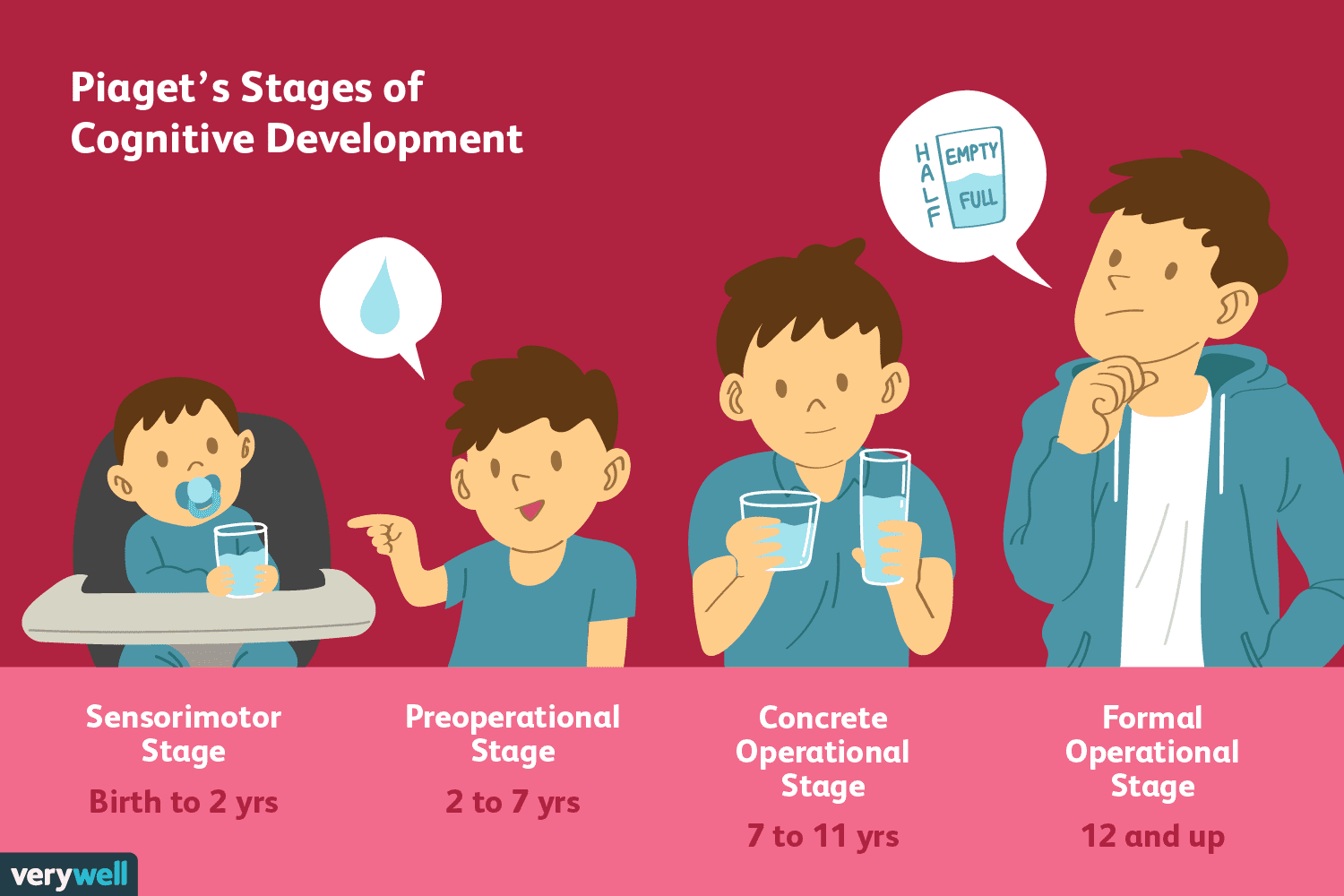
Jean Piaget’s Cognitive Development Theory explains how a child constructs a mental model of the world. He believed children pass through four universal, sequential stages of cognitive development, each representing a qualitatively different way of thinking.
Stage 1: Sensorimotor Stage (Birth – 2 years)
Definition:
Children learn about the world through their senses and actions (e.g., looking, touching, sucking).
10 characteristics
- Reflex-based interactions (e.g., sucking, grasping)
- Coordination of sensory input and motor activity
- Object permanence develops
- Egocentrism
- Trial-and-error learning
- Understanding of cause and effect begins
- Goal-directed behavior emerges
- Imitation of behavior
- Basic mental representations form
- No symbolic thought at the beginning
5 Educational Implications
- Use of sensory and motor activities (e.g., toys, play)
- Safe exploration environment
- Repetition for memory building
- Encourage physical interaction with surroundings
- Focus on concrete, hands-on experiences
Stage 2: Preoperational Stage (2-7years)
Definition:
Children begin to use language and think symbolically, yet thinking is still intuitive and egocentric.
10 Characteristics:
- Egocentrism
- Animism
- Centration
- Lack of conservation
- Symbolic play
- Irreversibility
- Limited cause-effect understanding
- Rapid language development
- Image and symbol-based thinking
- Difficulty with logic
5 Educational Implications:
- Encourage role-play and symbolic games
- Use visual aids and props
- Don’t expect logical reasoning
- Promote exploration for concept development
- Provide simple explanations and examples
Stage 3: Concrete Operational Stage (7 – 11 years)
Stage 3: Concrete Operational Stage (7 -11 years)
Definition:

Children develop logical thinking but only about concrete events. They understand the concept of conservation and can classify objects.
10 Characteristics:
- Conservation skills
- Classification of objects
- Seriation (ordering by size, etc.)
- Reversibility of thought
- Decentration
- Logical thinking about tangible objects
- Less egocentric
- Mathematical understanding develops
- Clearer cause-effect reasoning
- Struggles with abstract ideas
5 Educational Implications:
- Use real-life materials for teaching
- Encourage classification and sorting tasks
- Incorporate visual aids and step-by-step logic
- Support collaboration to teach different viewpoints
- Present logical sequences in teaching
Stage 4: Formal Operational Stage (12 years and above)
Definition:
Children develop the ability to think about abstract concepts, reason logically, and plan
10 Characteristics:
- Abstract thinking
- Deductive reasoning
- Logical problem-solving
- Metacognition
- Understanding abstract issues
- Hypothesis testing
- Thinking about future possibilities
- Flexible, creative thinking
- Scientific reasoning
- Use of complex symbols
5 Educational Implications:
- Encourage critical thinking and debates
- Introduce abstract models and theories
- Teach systematic problem-solving
- Assign independent research projects
- Foster scientific and hypothetical discussion
Summary Table:
| Stage | Age | Key Feature | Type of Thinking |
|---|---|---|---|
| Sensorimotor | 0–2 yrs | Sensory interaction | Non-verbal, motor-based |
| Preoperational | 2–7 yrs | Symbolic play | Egocentric, intuitive |
| Concrete Operational | 7–11 yrs | Logical thinking | Concrete, real-world logic |
| Formal Operational | 12+ yrs | Abstract reasoning | Hypothetical, deductive |



