
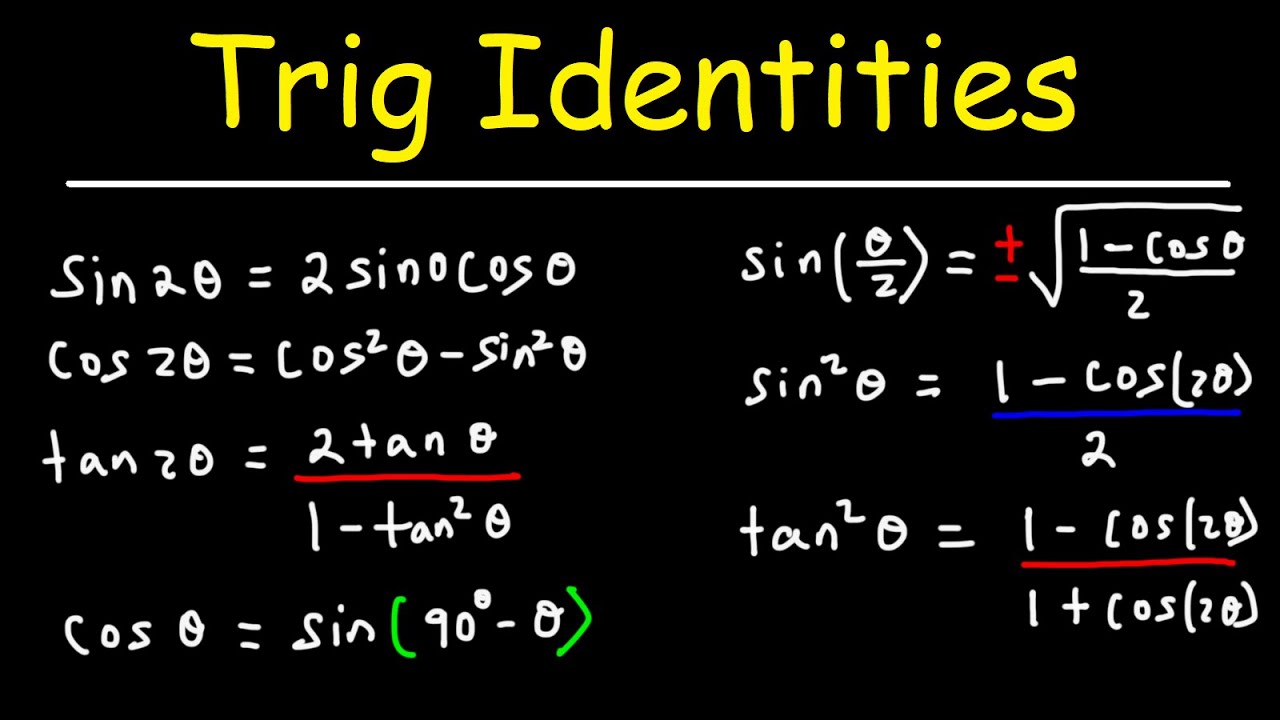

10 Common Trigonometry Identities — Simple Explanations
Use the triangle picture to remember Opposite, Adjacent, Hypotenuse.
Quick definitions (from the triangle)
These three come directly from the triangle. The other trig functions (sec, csc, cot) are just the flipped (reciprocal) versions.
1 — Reciprocal identities (flip)
sin θ = 1 / csc θ — sine is the reciprocal of cosecantcos θ = 1 / sec θtan θ = 1 / cot θExample: if sin θ = 3/5, then csc θ = 5/3 (flip the fraction).
2 — Quotient identities
tan θ = sin θ / cos θcot θ = cos θ / sin θThis works because both sin and cos have the same denominator (hypotenuse). Dividing cancels it out so you get Opposite/Adjacent.
Example: sin θ = 3/5 and cos θ = 4/5 → tan θ = (3/5) ÷ (4/5) = 3/4.
3 — Pythagorean identities
sin²θ + cos²θ = 11 + tan²θ = sec²θ1 + cot²θ = csc²θThe first is from Pythagoras: if hypotenuse = 1, adjacent = cos and opposite = sin, so cos² + sin² = 1.
Example (3-4-5): (3/5)² + (4/5)² = 9/25 + 16/25 = 1.
4 — Co-function (complement) identities
sin(90° − θ) = cos θcos(90° − θ) = sin θIf two angles add to 90°, the opposite side for one is the adjacent side for the other. So sine and cosine swap.
sin(90° − 30°) = sin 60° = cos 30°.
Extra notes & tips
- sin²θ means (sin θ)² — the whole sine is squared.
- Use the triangle picture to quickly remember definitions.
- To derive identities, try scaling the triangle so the hypotenuse = 1 (unit triangle) — many formulas become simpler.
Worked example — put it all together
Suppose you have a triangle with opposite = 3, adjacent = 4, hypotenuse = 5.
sin θ = 3/5
cos θ = 4/5
tan θ = 3/4
Check: sin² + cos² = (3/5)² + (4/5)² = 9/25 + 16/25 = 1 ✅
tan = sin / cos = (3/5) ÷ (4/5) = 3/4 ✅



